|
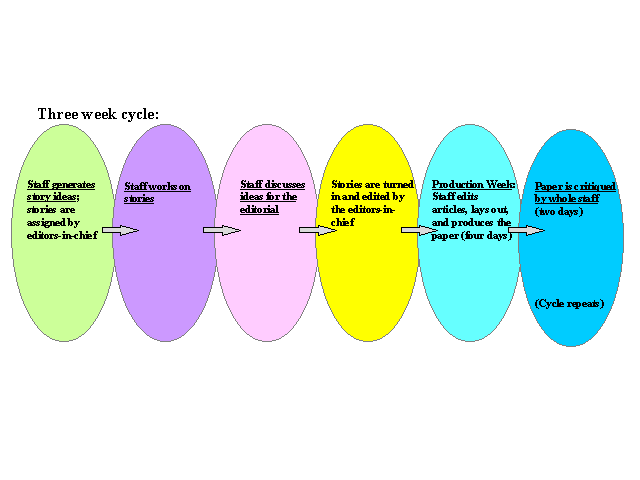
STORY IDEAS
Students must be allowed to brainstorm and come up with all kinds of crazy ideas, knowing that the ones which are too unusual will
probably not be used.
Story Idea Sessions:
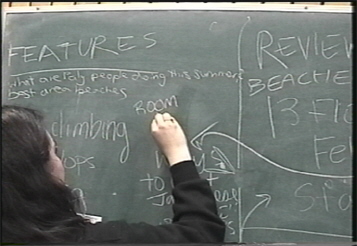
- Sessions are lead by editors
- Students first start in small groups; then go to boards, write down ideas
- Then students report to large group
- Story idea sessions must take at least two days
- Good story ideas are the foundation for good stories
- The day before students are given story idea sheets to fill out at home
- Anything goes, even crazy ideas during brainstorming
- Editors sift through ideas and pick usable ones when assigning stories
- Students are required to read a weekly newsmagazine
- Students required to read a daily newspaper.
- Students taught to be "the first to know something"
- Students come up with editorial topic
Back to diagram...
STAFF WORKS ON STORIES
Each student is responsible for a separate story. Sometimes students work in pairs, but
most of the time they need to work individually to cover all the news.
- Students work individually on stories but collaborate
- Students work collaboratively to help each other
- Students turn in stories for revisions by the editors
- Students are given 5 days to write their story
- Editors and Associate Editors work with reporters
- Photographers and artists coordinate with editors
- Students discuss editorial issues on a daily basis
Back to diagram...
EDITORIAL DISCUSSION
The editorial discussion is the most significant story idea discussion of the paper. Students
usually become polarized by the topic which makes for exciting discussions. Making students aware of the power of the editorial is key to getting students involved.
- Editorial topic is selected by the students
- Writing of editorial is done by students only
- Advisors and Administrators are in the advisory position only
- Students should be allowed to write editorial which are critical of the school if they do
not violate journalistic laws of libel or inciting to riot
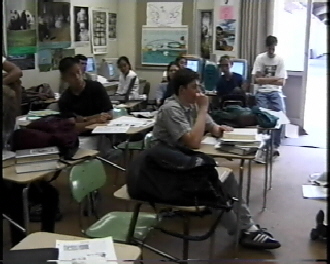
[video link under construction]
Back to diagram...
PRODUCTION WEEK
Production week is a time when each student's work in the previous two weeks becomes a
significant piece of a larger project. Each student plays a critical role in the production of the newspaper: reporters, editors, ad managers, artists, photographers. They all realize
how dependent they are on each other to produce this product. It is like a football game; each person has a defined role on the team and without that person, the game is flawed.
- Editors organize and are in-charge of production week
- Final revisions of stories are turned in ON DISK
- All photographs are gathered and organized
- All art work is gathered
- Page editors work with Associate Editors and Editors-in-Chief
- It is a collaborative effort on many fronts
- The adviser supervises, but does NOT control
- Students learn from making mistakes
- Advisers who are in control, prohibit students from learning from their own mistakes
- If students miss a deadline for the printer, then there is no paper
- If students failed to take a photo, then they should take one themselves, get it off the
web or forget it and change their layout
- Deadlines should be strictly maintained or students will not learn to deal with deadlines
- Food is provided during production week
- Students collect money at the beginning of the school year
- Students then organize the food distribution themselves
- Students learn to budget and shop for specials
- Students learn to clean up after themselves (parents love this one)
- Eating together provides a sense of community and excitement
- If the food distribution is poor, students complain to the Food Manager, not the teacher
- Students learn about nutrition.
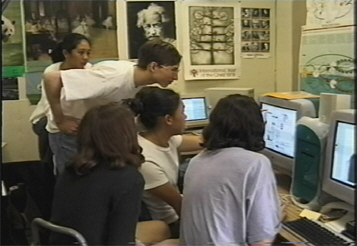
[Video link under construction]
Back to diagram...
CRITIQUE
The critique is a critical part of the learning process for students. To make progress
students must be must be willing to look at their mistakes and open to suggestions for improvement. How do you get them to think and behave this way? (see section on trust
building). The methods for critique are first taught and modeled in the beginning journalism program when students work is put on an overhead projector for everyone to examine and
discuss and revised repeatedly. Students learn through revision; they learn that it is always possible to improve writing and that all professional journalists revise and revise.
In the advanced program, these methods of critique are applied to the newspaper as a
whole. The critique process includes the following aspects:
- Students first find the good aspects of the page
- Then students discuss the areas for improvement
- The aspects of the page that are discussed include: layout, story location, and story content
- The paper is critiqued in numerical order; all students are on the same page at the same time
- Critique is made in the spirit of making the paper as a whole better
- Students are taught to be sensitive to other students feelings
- Students are taught not to take the criticism personally
- Students are broken up into small groups the day before to critique one aspect or section
- Small groups then report to the large group the next day
Following the critique, students then come up with story ideas for the next edition.
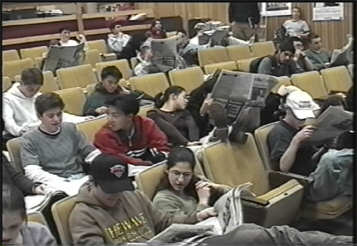
Click this link for an excerpt of a production week critique.
Back to diagram...
|