|
|
In what new directions have you taken your
investigation; has your question changed as a
result?
Initially, in my half of the project, we were looking
at the students in the workshop in mathematics class and how
their views of mathematics problems and problem solving
change. In focusing in on the class, I have become interested in
what exactly happens in a given day and what the students take
away from it. This has led me to the question: In what ways
can a problem solving class be viewed as a case study (in the
sense of the Shulman article "professing the liberal arts")?
Related to this we then reach the questions of: What aspects
of a problem make a valuable case-study for the classroom? and
What types of case studies prove effective in teaching certain
types of mathematical methodologies?
| |
|
What new insights or observations have resulted from
your investigation; what have you learned during the last few
months?
Perhaps the main insight for me has been that I want to understand better the
workings of the classroom dynamic for discussion and learning
in this unusual class. I believe that the framework of a case
study for each class, where the problem of the day becomes a
case is a useful tool.
In looking at the classroom and faculty interviews, defining/naming is a skill that math
majors often carry outside of the classroom (in both good and
bad ways), and yet one that students clearly do not
start with in the workshop class. Thus I have been attempting
to use the problems to address this skill in a way that the
students must focus on how they will present a solution and/or
attack.
| |
|
|
How will you move your project toward closure
between now and June?
To move forward, I will
transcribe several of the classes that I have digitally
recorded. I will then analyze these classes and look at
student reflections, my reflections, and others reflections on
the classroom. In addition, I will set up two to three
specific classes that I will digitally record and have
observed for continuing this effort. One of the key features I
want to look at is what I, as the instructor, learn about the
students' knowledge and how to further their learning in terms
of the problems. Related to this will be a look at one or two
students in detail and how classes affect the students' poster
presentations.
By June, I would like to have an outline of how problem
solving experience correspond to case study, and what sorts of
experiences are helpful to learning.
| |
|
|
What evidence/data have you collected and/or what
are you preparing to draw on as you continue your
inquiry?
We have collected a mountain of evidence. I have three
digitized problem solving works from the classroom. We have
surveys filled out by 54 students in math classes. The
students cover nearly all of our mathematics majors and all of
the students in the workshop class. In addition, we have taped
5 interviews (I was present for 3) with faculty in other
disciplines at LMU about mathematics majors and what
mathematical skills they bring to other disciplines. Finally,
we have student coursework, including fall term portfolios
containing their work and reflections on problem solving
experiences in the classroom.
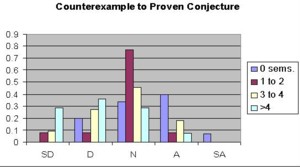
Survey data
This is the raw survey data.
I have included on Sheet1 a few bar charts.
Correlations
This is the statistical
package file on the survey with correlations. 95% confident
correlations are immediately above green, 90% above yellow and
80% above orange.
Survey
Questions
| |
|
What questions do you have about your investigation;
where can you go for assistance?
I'm still not sure where I am heading in the end. I
want to understand the class better, what I am learning about
the students' knowledge better, and what I can do to influence
the students towards richer methodologies. Thus, I am unsure
how best to study the classroom record. I am also wonder what
level of credence to give to students' interpretations of the
classroom setting. Another question is whether I should try
and do a group interview of the students or of a smaller
subset. I somehow think this might be the most helpful to me
as a teacher, but I don't know in terms of the SoTL work.
Finally, I am wondering which subset of my evidence I should
analyze most carefully, and what type of analysis would be
most effective for me to do (recognizing my limitations
in analyzing qualitative data).
I will continue to work with Jackie, look to the
literature for frameworks that I can use to analyze the class,
and talk with colleagues in mathematics education.
| |
|