|
|
The Background
Questions that drove the study: 1)What knowledge from their mathematics learning do students transfer to the rest of their lives? 2) What is the evolution of a student's perception of the role of and need for proof? 3)
What is the role of the mathematics workshop sequence (MATH190/191) in
students' understanding of proof and how do they see their knowledge
applied more liberally?
|
|
|
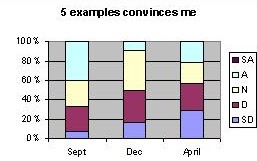
| Change in student understanding of proof |
|
|
Implications for Teaching
- Typology can be used for targeting instruction and gives
language for complexity of the task. (Particularly as epistemic
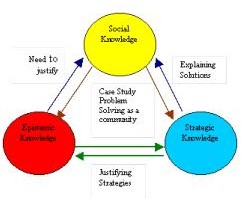
knowledge has factual, procedural, schematic, and strategic knowledge
components)
- Epistemic learning is enhanced by community
- There is a risk of learners partitioning themselves into the
"cans" and "cannots" that can be alleviated by tasks with initial
(solo) time insufficient for completion.
- Habits of mind are skills most likely to transfer - they need to be incorporated into core classes
|
|
|
|
| Knowledge interaction in workshop class |
|
|
|
A Typology and Taxonomy of mathematical knowledge
As
a first part of the project we developed a typology/taxonomy of
mathematical knowledge. The categories of the typology are adapted from
other works: The work of Duschl and Shavelson on science assessment,
Alexander's work on Model of Domain Learning
Domain Learning Typology in math
This is a grid of knowledge types versus model domains of learning that Jackie and I set up.
|
|
Selected Bibliography
- Alexander, P. (2003) The development of expertise: the
journey from acclimation to proficiency. Educational Researcher. 32(8),
10-14.
- Barnes, L., Christensen, C., Hansen, A., Premises and
Practices of Discussion Teaching in Teaching and the Case Method,
Harvard Business School Press, Boston, 1994, 23-33.
- Duschl, R. (2003), Assessment of Inquiry, in Everyday
Assessment, edited by J. Myron Atkin and Janet E. Coffey, NSTA Press,
Arlington, 41-60.
- Pirie, S.E.B. and Kieren, T.E. (1989), A recursive theory of
mathematical understanding, For the Learning of Mathematics, 9 (3),
7-11.
- Recio, A.M., and Godino, J.D. (2001). Institutional and
personal meanings of proof. Educational Studies in Mathematics, 48(1),
83-99.
|
|
|
Evidence Gathered
- Student interviews
- Surveys of math majors (open-ended and Likert scale questions).
- Digital audio-tapes of 7 MATH 190 class days.
- Interviews with faculty from other disciplines (2 Education, 1 Philosophy, and 1 English).
- 12 Student "proof aloud" interviews.
- Student work from the MATH 190/191 course.
- Interviews with workshop students.
- Student focus group
|
|
|
Emergent Results
- Student knowledge progresses through major (chart)
- The Mathematics Workshop plays a significant role (course)
- Community is critical to student learning
- 15 minute problems play key role
- Student interest in explaining ideas to others plays a key role in social
learning
- Habits of mind and writing skills transfer
|
|
Pitfalls
- More data collected than could be analyzed in time frame.
- Professors in disciplines unwilling to ascribe differences
of mathematics students to their mathematical training, but education
professors more willing.
- Rubrics we intended to use were not complex enough
|
|
|