|
|
Project Description: The
Hewlett grant helped to fund the expansion of a Faculty Colloquium for
New Learning Environments, designed to build a community of faculty
inquiring into student learning. In partnership with librarians,
technology specialists, and evaluation professionals, faculty developed
the strategies and technology tools to improve instruction in
sustainable ways.
|
|
|
This
project was built around introductory and core courses focusing on
inquiry-driven pedagogies that bridge expert learning strategies and
novice learning, such as problem-based learning, work with primary
materials and data, development of skills in reflective, problem-driven
research, and an acquaintance with methodologies and mindsets of
disciplinary practitioners. The project especially emphasized the use
of virtual teaching environments and online research environments as
tools that enable these teaching and learning strategies.
|
|
|
Highlights: - The project combined three essential ingredients:
(1) Attention to expert/novice learning process, (2) reflective
pedagogy (including the scholarship of teaching and learning), and (3)
innovations with educational technologies.
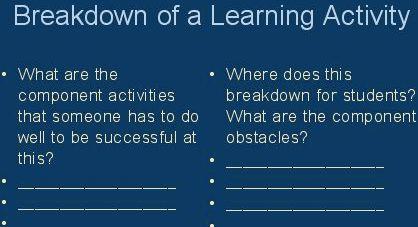
- One of the key faculty development activities we created for this initiative was an exercise we call the "Learning Activity Breakdown";it
helps faculty focus on the relationship between their own thinking
processes and student behavior in the context of particular learning
tasks.
- The project was from the beginning integrated with the structures of already established faculty development programs
at Georgetown, namely the Faculty Colloquium on New Learning
Environments and the Teaching, Learning, and Technology Summer
Institute.
- The Hewlett funds were critical in building the relationships among these programs and in enabling us to build a significant community of faculty engaged in reflective change.
Over the course of the two years, 56 faculty participated in one or
more phases of the sustained programs; more than 200 faculty
participated over the two-year period, counting the Teaching, Learning,
and Technology Summer Institutes.
"CYCLES" document of the Hewlett Project
This is a chart representation of all the Hewlett participants in both
the Colloquium and the TLT Fellow Program. The building and overlapping
nature of the programs was integral to the project design, insuring
both breadth and depth of participation, as well as an iterative base
for building community.
Listing of all Hewlett Project Participants and their Project Interests
This is a complete listing with notes/descriptions of all the Colloquium participants and Hewlett Fellows from 2001-2003.
|
|
|
Impact Beyond the Project The
Hewlett Project has also had a broader impact on individuals and
potentially beyond the campus. Some of the ares of impact include: - Many
of the expert/novice learning theories and pedagogies developed under
the Hewlett Project also informed the development of what is now called
the "CADE" methodology for course design through the JesuitNet network
of 23 schools.
- The Learning Activity Breakdown and related methods have been disseminated through several public workshop presentations.
- Jen
Swift, (2003 Hewlett Fellow) received a National Science Foundation
Innovation grant ($48,000) to develop and assess a collaborative module
for Organic Chemistry, that was the focus of her Hewlett Fellowship.
- Heidi
Elmendorf (2002 Hewlett Fellow) was selected as a 2003 Carnegie Scholar
in the Carnegie Academy for the Scholarship of Teaching and Learning.
|
|
|
Connections to Other Campus Initiatives: - The Hewlett project was housed in the Center for New Designs in Learning and Scholarship (CNDLS) and
consequently the funded activities were carefully integrated into other
faculty development and curriculum innovation activities.
- The Hewlett intiative intersected with another major on-campus initiative known as the College Curriculum Renewal Project (CCRP). The CCRP focuses on innovation in the College curriculum, with significant emphasis on general education.
- In
developing collaborations around the Hewlett Fellowships, we sought
partners who could co-fund fellowships and link Hewlett activity to
other programs. Two examples of funding collaboration include the
Georgetown Writing Program and the Center for Social Justice Research, Teaching and Service.
- The Hewlett Project intersects in significant ways with the Visible Knowledge Project
(VKP), a five-year national scholarship of teaching and learning
project exploring the impact of technology on learning. Some Hewlett
Fellows are now also part of the Georgetwon VKP faculty research group;
many of the ideas about expert/novice learning have developed jointly
through the Hewlett activities and VKP.
Center for New Designs in Learning and Scholarship (CNDLS)
College Curriculum Renewal Project (CCRP)
Georgetown Writing Program
Center for Social Justice Research, Teaching and Service
Visible Knowledge Project
|
|
|
RESOURCES Some key resources and background for the work of the Hewlett Project include: - Bransford, et. al. How People Learn. National Academy Press, 1999.
- Wineburg, Sam. Historical Thinking and Other Unnatural Acts. Temple University Press, 2001.
- Eisner, Elliot. The Englightened Eye: Qualitative Inquiry and the Enhancement of Educational Practice. Prentice-Hall, 1998.
JesuitNet CADE design approach description:
|
|
|
The
Learning Activity Breakdown is one of several faculty development
templates or tools used in the Hewlett Project (see description column
right). Another key tool is an "evidence template" where faculty are
asked to identify the key competencies inplicated in a course and
describe with some detail what passes as evidence of those competencies
("how do you know when a student knows") as well as identifying levels
of competency: what qualifies as novice and advanced levels. (See
Sandefur link below for example).
|
|
|

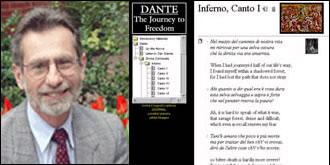
The
Hewlett project helped fund faculty to undertake redesigns of course
materials and pedagogies, such as this one on
"Dante," featuring a fully digitized version of The
Divine Comedy.
|
"Clearly,
one challenge was for me to ask myself questions about my role as
instructor and my pedagogical relationship to the students' learning
activity. That issue was not fully formed in my mind when I joined the
Colloquium, but became the focal issue of my participation in it." --Frank Ambrosio (Philosophy), Hewlett Fellow 2002-2003
|
|
|
CASES from the PROJECT Frank Ambrosio: "Digital Dante: Helping Students Learn to Read Contemplatively and Reflectively" Frank
Ambrosio's project focuses on a course devoted to reading Dante,
investigating which course activities were most effective in helping
students overcome the obstacles in learning to read literature
contemplatively and interpret reflectively. Use of an on-line journal
provided the main evidence of student learning. As part of his Hewlett
Fellowship, Frank focused on the development of the journaling tool and
student journal entries. He found that the journal entires were a key
place where connnections between instructional materials (expert ways
of reading) and student development (novice reading strategies) were
occurring effectively.
Read more about Frank Ambrosio's project.
|
|
|
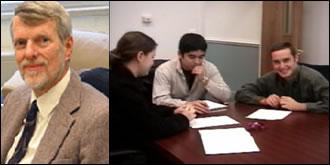
CASES from the PROJECT Jim Sandefur: "Using Think Alouds to Help Student Problem-Solving in a Foundations of Mathematics Course" Jim
Sandefur focused his Hewlett-funded explorations around better
understanding of student problem-solving processes. Initially he used
think-aloud techniques to get access to the ways that students were
thinking about problems and drawing on a repertoire of methods. His
three semesters of investigations have led to pedagogical adjustments
including more group work and communication between students about
problem-solving strategies and oral presentations as a regular feature
of the course. Read more at the link below.
Read more about Jim Sandefur's project:
|
|
|
CASES from the PROJECT Heidi Elmendorf: "Engaging Liberal Arts Students in Science: Exploring Experiential Learning" Heidi's
project began with her participation in the Faculty Colloquium,
developing ways of increasing interactivity in a large lecture-based
introduction to biology course. Observing that her students were often
more engaged as developing scientists when the material was presented
in multidisciplinary discussion and research contexts, she focused the
development of a course on microbiology for non-science majors around
opportunities for understanding science in applied contexts and
experientially. Her Hewlett Fellowship centered especially on the
development of a "reciprocal teaching" component in her liberal arts
microbiology course where students may opt, in lieu of a lab, to
develop curriculum units on biology for DC urban elementary school
students.
Read more about Heidi Elmendorf's project.
|
|
|
Elizabeth Stephen, "The Use of Film in a Freshman Seminar on Immigration" A
demographer by training, Betsi wanted students to experience the study
of immigration through stories as well as statistics, images as well as
data. The focus of her Colloquium project--and subsequent work in the
Visible Knowledge Project--has been on the use of film as an integral
part of the course: What is it about film that facilitates or detracts
from student learning? Does the superficial treatment of complex topics
in some films diminish students' exploration? How do students make
linkages across films and texts to more fully understand sociological
and demographic concepts? Her course design -- and scholarship of
teaching and learning project -- has been an interesting experiment in
understanding some important dimensions of introducing
interdisciplinary materials on complex topics to novice students.
Read more about Elizabeth Stephen's project.
|
|
|
|
Findings and Outcomes: The
following synopsis of goals and outcomes is based on the three key
goals outlined in the proposal. Each of the individual course projects
has its own goals and findings; these are the global findings. Goal (1) Form a community of faculty reflective about their teaching and learning goals in a research university environment.
Develop an embedded knowledge base on inquiry-guided learning and the
scaffolding and infrastructure to support it beyond the
external-funding period. Goal (2)
Improve student learning in a variety of general education and
introductory science courses, especially through inquiry-based
strategies, student awareness of learning dimensions, understanding
of expert practices separate from content, and facility with research,
inquiry, and collaborative knowledge-building practices, including work
in new environments. Goal (3) Create a set of models and modules,
course and assignment designs, that are available and usable to other
Georgetown faculty beyond the 46 in the Hewlett-funded project.
|
|
|
GOAL: Build Faculty Community It
is possible, but not easy, to form a community of faculty reflective
about their teaching and learning practices in a research university
environment. Throughout the Hewlett funding period we saw significant
increases faculty participation: in 2003 we had the largest Colloquium
ever (28), 40 applications for the second year of Hewlett/TLT
Fellowships, and 198 faculty and graduate students at the 2003 Summer
Institute.
|
|
|
We identify several factors leading to this increase and development of community: - Designing
multiple venues for participation--with differing degrees of
commitment--is crucial for building community; varied programs included
short term workshops (Summer Institute), year-long modest commitment
(Colloquium), two-year substantial redesigns (Hewlett Fellows).
- The
reciprocity between pedagogy and technology innovation is very powerful
in building credibility of faculty who can be engaged in reflective
teaching issues.
- Reflective practice and a focus on learning must be a part of every program, even if in varying degrees.
- Most
faculty -- absent of other pressures -- prefer their favorite majors
courses as the venue for innovation over general education courses.
Rather than resist or artificially reverse that, we chose to work with
many of these courses as "laboratories" to develop modular components
with a "research ethos" that would later be portable to general
education courses.
|
|
|
GOAL: Improve Student Learning We
wanted to improve student learning in a variety of general education
and introductory science courses, especially through inquiry-based
strategies, student awareness of learning dimensions, understanding of
expert practices separate from content, and facility with research,
inquiry, and collaborative knowledge-building practices, especially in
new environments. - The
overall approach of expert / novice thinking, when worked through as a
process, proved an effective way to engage faculty with issues of
learning. An important step with faculty was getting them to shift
their attention from traditional content goals to becoming explicit
about intermediate skills, even those that are not directly evaluated.
- Expert/novice
thinking can be effectively linked across disciplines to pedagogical
foci on problem-solving, practitioner thinking, and approaching
ill-structured problems.
- Techniques
for doing scholarship of teaching and learning inquiry for faculty
(such as think alouds, pre/post reflections, etc) can become effective
pedagogies as well. Many classroom research strategies led to new
pedagogical strategies.
- Technologies
that enable students to make visible their intermediate thinking are
often key components of redesigned courses, such as: online discussion
with an emphasis on process and iteration, online journaling, posted
drafts of papers, and peer commentary, use of hypertext multimedia to
amplify close reading, and creating Web trails of research paths.
- New
media technologies, in combination with pedagogical strategies focused
on transferring expert-like processes, can greatly facilitate the
transfer of upper division apprenticeship pedagogies into lower
division general education settings.
|
|
|
GOAL: Create a Set of Models and Modules Throughout
the project faculty, in conjunction with CNDLS, have developed an array
of models for enhancing attention to expert/novice learning applicable
to general education courses. Some of these are outlined in the cases,
such as those linked off this overview. Also developing out of the
project was a set of processes by which faculty could engage with these
questions and apply their own responses to their own course redesigns.
Three of these are described below: An effective investigation tool for some faculty is the use of video taped think alouds.
In several Hewlett related projects, CNDLS staff worked with faculty to
use think alouds as a means to give teacher's access and insight into
parts of student thinking processes they would not have access to
otherwise. (See Sandefur case study, for example). We used the "Learning Activity Breakdown," (LAB)
to slow down faculty reflection to look at the components of succes
that made up a particular activity (usually modeled on expert thinking
processes but often including intermediate stages usually left tacit).
The LAB asks faculty to identify down one column the steps required for
success in a particular activity; down the other, obstacles. Often,
faculty are not able immediately to fill in the right-hand column with
much detail. That then opens the door to the reflective inquiry
strategies outlined above, such as "think aloud" exercises. (see
graphic in left column). Building
on the ideas behind both techniques is an array of pedagogical and
course redesign strategies coming out of the projects that more often
than not point to the goal of putting the teacher in a position to spend more time coaching student thinking in the middle of thought
and not at the end of it. Although this is often captured in ideas such
as "rapid feedback" and "time on task," without the reflective and
inquiry activity described above to help faculty see what processes
need coaching most and when, such "good practices" can remain
abstractions or platitudes.
|
|
|