Faculty Collaboratives for Teaching and Learning

Nazareth College

Project Director: Diane M. Enerson, PhD

October 2002 to June 2005

Amount: $150,000

Project Description

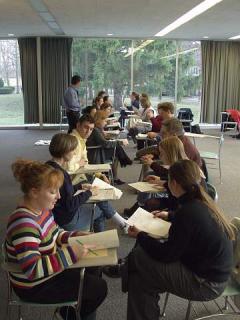
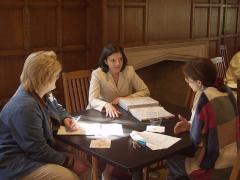
Through the generous support of the Hewlett Foundation, Nazareth College recently embarked on a pilot project, the Faculty Collaboratives for Teaching and Learning. This project took as its starting point a notion of faculty development that revolved not around pre-established issues or preset agendas but around the creation of faculty discussion groups (i.e., teaching circles) that are rooted in the liberal arts tradition of a democratic process via collegial discourse. Each teaching circle group had the responsibility of framing a question or series of questions that they then agree to pursue via collaborative group process and shared discovery. Focal problems were negotiated by the group and meant to address perceived faculty needs. Faculty then met in a series of discussions (typically 3-4 times per semester) aimed at exploring their identified problems.

Center for Teaching Excellence at Nazareth College


Nazareth College Project Highlights

Participation in the teaching circles began slowing but significantly. The pilot began with a total of 15 faculty members divided evenly among three teaching circles. By the end of Autumn Semester 2003, nearly a dozen different circles had formed or were in the process of forming.

Initially, faculty were encouraged to participate in the teaching circle discussions by offering a small stipend. However, it quickly became clear that the small stipend was not much of an enticement; at best it was a gesture acknowledging commitment. What faculty preferred wasn't compensation for attending as much as the promise of institutional commitment of resources in tandem with the freedom to choose their own problems and course of problem solving. If they got a great idea for changing and improving a course, they wanted to know support would be there to help them implement it.

And once the commitment to a circle was made, what transpired during these circle discussions?

Topics for discussion were quite varied. Some faculty reflected on the role of computer technology in the process of teaching and learning. Did it make a difference? And under what conditions? Others considered whether the topics of an introductory sequence are best grounded in the topics or process of a discipline. What does the novice learner need to know as they begin their studies in a field? What can they learn later? Others considered the inescapable issue of globalization. How does it affect who we are as people, and who we are as teachers? What is its impact on our ability to cope with the needs of diverse learners in the day-to-day realities of the classroom?


Next Steps

We have begun to test a prototype for the learning circles and to gather information about how this experience might be sustained and expanded. The feedback to date has been positive and encouraging. In the months ahead we will be looking more closely at the specifics of individual group dynamics and their effects on specific outcomes. We must also soon address the question of how to sustain and expand the initiative. Finally, what is the real impact of these collegial teaching circles? Does participation in one teaching circle fulfill a basic need? Or does good faculty discussion, like good education become a lifelong process?


Comments from HEWLETT Teaching Circle Participants:

Q What made group discussions work?

"These conversations make us better teachers by helping us be more intentional and think more critically about our teaching; enhance the interdisciplinarity of our teaching by giving us the chance to meet and talk with people in other fields; raise faculty morale by allowing us the pleasure of talking with others about this work we love."

We rarely have the kinds of opportunity afforded by these circles to do the scholarship of teaching. The majority of our faculty development is of the outdated, marginally useful, an expert will tell you what we think you need to know variety. These circles respect and enable us to grow as autonomous, thoughtful professionals.

"This kind of discussion is a great opportunity to reflect on what we do and why we do it; it enhances the collegial atmosphere here and should continue."

Its important to reflect on teaching methods with colleagues. This type of group allowed for stepping back and looking at what works and what doesnt work, and to reflect on the objectives of various classroom experiences. It allows for sharing between experienced professors and those in the earlier stages of their career.

"The discussions contribute to continuing a sense of community among the members of the college across disciplines."

The discussions celebrate the interests and accomplishments of individuals and familiarize us with their activities.

"The discussions affirm the value of collaboration. They give us a purpose and focus not just for meeting together but for being together as an institution."

I simply enjoyed talking with my colleagues about teaching. I felt less isolated by being in a circle. I am inspired to reflect on and approach my teaching differently. I have found the group discussions and debate intellectually stimulating.

"The interdisciplinary nature of the discussion was particularly helpful. Everyone there represented a different discipline, issues were dealt with from different perspectives."

Eating together creates a communion or community of sorts and lessens reserve. We get more comfortable with each other more readily, and thus we are able to talk about a range of teaching issues, immediate and theoretical.

"An open atmosphere that allowed the participants to choose the objectives and the facilitator took it from there. The book that I read was relevant, understandable, and practical. I found for the first time that I could actually implement new teaching strategies without getting frustrated."

Our group is very open to discussion and is very supportive of each member. I find the conversations refreshing. They stimulate me to think more about my teaching practice and to evaluate the effectiveness of what I am doing.

"The readings served as a backdrop to, or frame for, ongoing issues in our teaching/scholarship."


Impact

Although we are only half way through this pilot, already some interesting findings have begun to emerge.

The compositions of the groups have varied considerably, as has the nature of the problems they sought to solve. Those who participated have come from every rank. Some were new to Nazareth and/or new to teaching, while others had been teaching here (or elsewhere) 30 or more years. Many of the circles that have formed have been interdisciplinary in nature, whereas others have found it useful to frame questions from a strictly disciplinary perspective. Yet despite these differences there has been a remarkable uniformity not just in the discovery process involved but also with regard to the impact of that process. These similarities have been especially clear in the reasons they give for why they participated, the benefits of that participation, and their reasons for what made these discussions work.

Why had they participated? The most frequent reasons chosen were also the most straightforward. All of those who had participated had done so for one or both of two fundamental reasons:

1) they wanted to have an opportunity to meet regularly with colleagues to talk about an issue or issues related to teaching (89.3%); and/or

2) they wanted to learn about new strategies and new approaches to common pedagogical problems in their classes (71.4%).

What had been the benefit of their participation thus far?

Again, despite the diversity of groups, the outcomes of participation have been remarkably similar. Almost to a person (92.9%) faculty perceived these discussions as intellectually stimulating. Most (71.4 %) have been inspired to reflect on and approach their teaching differently, which for many also included a benefit of simply enjoying talking with colleagues about teaching. Many (53.6%) also noted that they felt less isolated by being in a circle. A number of faculty members (17.9%) even indicated that the experience had allowed them to rediscover the unique benefits of the liberal arts experience. Roughly half indicated that they had implemented small changes and new activities in a course(s) while another subset had taken on larger changes through course revision and large-scale improvement. To date, a total of 16 course projects have been supported by the process. The results and report of those efforts are still pending. But we are hopeful.

Finally, there is the ultimate test of any faculty or teaching development initiative: student learning.

Although few of the groups have taken the issue of student learning as their starting point, nearly a fifth of those who participated report that they had seen a clear improvement in student learning as a result of their own participation in a circle discussion.

What made it work thus far?

Here again, participant feedback is unequivocal. For those circles where this was possible, it was the interdisciplinary nature of the discussion that was crucial. But equally helpful has been the opportunity to determine their own course toward self-determined objectives in an atmosphere of collegial respect and shared discovery. Their comments make this clear.


This electronic portfolio was created using the KML Snapshot Tool™, a part of the KEEP Toolkit™,
developed at the Knowledge Media Lab of The Carnegie Foundation for the Advancement of Teaching.
Terms of Use - Privacy Policy