|
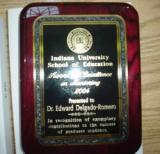
Mentoring Award 2004
|
GWEN Mentoring Award Each
Spring, GWEN, requests nominations from doctoral students throughout
our School's 19 Ph.D/Ed.D program areas. A great deal of effort is made
to make sure everyone knows that GWEN is the organizing body, but that
both men and women can participate in all GWEN activities including the
Mentoring Award. A panel discussion on mentoring is held in the spring
at the beginning of the nomination period to discuss the nature of
mentoring and provide people to discuss what they believe good
mentoring to be. The
nominations consist of individually composed essays which broadly
address the mentoring relationship between the nominee and the doctoral
student. All of the essays are then read by the executive council of
GWEN. In some years, depending on the number of nominations, interviews
are also scheduled with the short-listed nominees. Each year between
2-3 faculty members receive the Award, but all of the nominees are
formally recognized both in writing and at the Mentoring Award
ceremony. The ceremony is the culmination of the Award process and
includes a keynote speaker as well as speeches by the awardees on their
mentoring philosophy. The event is extremely well-attended and often
discussed in faculty and student groups afterwards.
|
|

Award Ceremony Set-up
|
Additional Technical Details Any doctoral student in the School of Education can participateGWEN
runs the program with financial support from the Office of Graduate
Studies in the School of Education and the Graduate School at IUB. It was implemented because both faculty and students discovered that mentoring did not receive enough recognitionIt was implemented for the first time in 2002 Special Attention was paid to creating a formal award ceremony in order to convey how important this award is to the students.
Call for Nominations
This is the call for nominations for 2004.
Sample Nomination One
This is an example of the type of nomination often received. The person nominated in this letter did not receive the award.
Sample Nomination Two
An example of a nomination for a mentor in the student's minor area
|
|
|
|
What educational purpose does the GWEN Mentoring Award serve? As
mentioned above, the Award serves to focus attention on mentoring as an
important activity. It provides an annual and public recognition of
mentoring. Further, as a student-run process it empowers. Students are
able to not only recognize those faculty members who have been and
continue to be excellent mentors, but they are able to make clear that
mentoring is not something they hope to receive, but rather believe
they have a right to receive. Likewise, the conversations which result
underscore the responsibility on the part of the mentee and the mentor
to contribute to the mentoring process.
|
|
|
What data or evidence tells us that this works? Since
this project emerged in response to conversations between students and
faculty and is neither a formal policy nor a program, there is no
direct data. However, anecdotally since the GWEN Mentor Award began,
conversations about mentoring and recognizing mentoring have increased.
A review of Policy Council, Graduate Studies Committee and Faculty
Meeting minutes, reveals conversations about the importance of the
award, need to support the award and what nomination represents for a
program area. Also, the annual faculty review process recognizes
receiving the award as a significant teaching contribution.
|
|

GWEN Student Leaders at 2004 Ceremony
|
Reflection from student leaders We
were part of the original team of students who organized the first (and
second) GWEN Mentoring Awards. We have see the project become a
mainstay of the spring semester at the School of Education and are
excited in particular by the faculty high regard for the process. It
has become a coveted award and in so doing raises the expectations for
mentoring and recognition of mentoring as an important process. We
believe the project has also been personally quite rewarding and
empowering as participation really emphasizes the relational aspects of
mentoring--that is we as students are a much a part of mentoring as the
mentors themselves. Our
concerns for the future lie in continued strong leadership from the
student side and that criteria for good mentoring continue to be
reflected upon. We believe strongly that individual students and
professors develop their own ways of mentoring--the Award needs to be
flexible enough to recognize alternative model. Reflection on mentoring
and how it changes is as much a part of the Award as the giving of the
Award itself. Rebecca, Debi and Debora (Curriculum Studies, Science Education, Educational Policy)
|
|
|

Dr. Anne Dopkins Stright, Associate Professor of Educational Psychology, Winner 2002 GWEN Mentoring Award
|
Reflection from faculty members Please see attached document.
Reflections on Award
Previous recipients share their thoughts about winning.
Faculty Profile of Dr. McClellan
Dr. McClellan, Professor Emeritus of History of Education, Recepient of 2003 GWEN mentoring award
Faculty Profile of Dr. Brantlinger
Dr. Brantlinger, Professor of Curriculum Studies, Recepient of 2002 GWEN mentoring award.
Faculty Profile of Dr. Stright
Dr. Stright, Associate Professor of Educational Psychology, Recepient of 2002 GWEN Mentoring Award
Faculty Profile of Dr. Sutton
Dr. Sutton, Associate Professor of Educational Policy and Comparative Education, Recepient of 2002 GWEN mentoring award
Faculty Profile of Dr. McMullen
Dr. McMullen, Associate Professor of Curriculum and Instruction, Recepient of 2004 GWEN mentoring award
Faculty Profile of Dr. Delgado-Romero
Dr. Delgado, Assistant Professor of Counseling Psychology, Recepient of 2004 GWEN mentoring award
Faculty Profile of Dr. Sexton
Dr. Sexton, Associate Professor of Counseling Psychology, Recepient of 2003 GWEN mentoring award
|
|
|