|
|
Rationale In
a traditional science lab course, students perform an experiment, take
pencil notes of the data, and postpone the analysis and verification of
outcomes for some out-of-class period. This has the disadvantage of
separating the measurement and data input, and the analysis processes.
If doubts or problems should rise after students leave the lab, they
cannot clarify or correct errors. To
overcome these shortcomings, we are using Tablet PCs to do most of the
experimental and analysis procedures in-class. Thus, the laboratory
experience is enriched with real-time results. For example, using Excel
worksheets instructional modules have been developed to immediately
produce graphs of data placed into pre-configured Excel tables.
Students can also vary data input to study what would happen if data
results were different. In summary, students are able to come out of
the lab with a better grasp of the experimental outcomes, rather than
postponing data analysis for out-of-class periods, well after the
experiment takes place.
|
|
|
Implementation (pedagogy) Historically,
students in the Natural Science Department at University of Puerto Rico
at Aguadilla were taught laboratory procedures on Molecular and
Cellular Biology through lectures preceding practice. Students were
required to hear verbal descriptions of various topics, watch
demonstrations of several experimental techniques, and afterwards
perform an experiment. Data measurements were registered by taking
pencil notes. The students were encouraged to consult either an
instructor or a reference textbook if they had questions about the
analysis and verification of outcomes. Complaints
from students suggested that, since the analysis of data was postponed
for out-of-lab periods, they could not be sure if the procedures were
in fact carried out correctly. Instructors realized the difficulties
stated by the students were hindering the development of a good
understanding of the laboratory techniques and their applicability to
research and industrial work. In response to this situation a new
approach is now being attempted. Ten computer-based modules have been
developed as flexible resources for use as manual for the laboratory
course on Cellular and Molecular Biology. Since commercial multimedia
products and laboratory manuals did not address the specific concerns
raised by our students, nor reflect the exact content of our
curriculum, multimedia units that might include animations, computer
simulations, video clips, focus and inquiry questions, and links to
related information have been created. The
instructional and technical expertise of The Multimedia Educational
Technology Center (MET-Center) has been instrumental towards our goals.
The Center has provided our instructors with guidance for the
instructional design of our modules and supported the training of our
students in the development of Information Technology skills. Also,
through their locally developed Course Management Software, MET-Center
is also serving as webhost for our modules. See http://imej.wfu.edu/articles/2003/1/02/index.asp MET-Center home site: http://www.cetem.upr.edu/ MET-Center course site: http://cetem.upr.edu
|
|
|
Implementation (technology) A
set of ten instructional modules has been developed to be used as a
manual for the Laboratory of Cellular and Molecular Biology. The
instructional modules include animations, computer simulations, video
clips, focus and inquiry questions, as well as other related web links.
Each instructional module has been uploaded on a server to be accessed
online through the University website course manager (Paginas Academicas).
On each laboratory exercise students have the opportunity to use a
Wireless Tablet PC to access specific instructional modules. The
instructor uses a Tablet PC to explain the technical information and
the laboratory procedures, as well as to create and organize concept
maps and show related mathematical calculations. Students use the
Tablet PCs to follow the instructor explanation, take notes about
important concepts and experimental observations, perform all the
mathematical calculations needed for the experimental procedure,
prepare graphics and tables with the results, and answer the pre-test
and post-test. The modules provide related links to the information
needed to solve the scientific and research problems that come across
during the implementation of a particular technique.
|
|
|
Impact on Teaching The
first goal of this project is to improve the teaching of science
laboratory courses by expanding the laboratory experience to include
both data input and computer data analysis during the in-lab exercises.
The second one is to develop basic science related computer skills that
will transfer to other science courses and, after graduation, to the
workplace or graduate study environment of the student. This project
will be successful if: 1) Students develop a good understanding of the
laboratory techniques and their applicability to research and
industrial work. 2) Students learn to use the computer as a research
tool to obtain more information to solve the problems they encounter in
the development of a particular technique. 3) Students strengthen their
problem solving skills by using the computational capabilities of a
computer for numerical and graphical analysis.
|
|
|
|
Impact on Student Learning One year ago,
student outcomes were measured by grades on hand written lab reports
and on the final exams. Although on average students graded B-, they
had problems with execution of the laboratory procedures and data
analysis. Today,
student outcomes are measurable by grades on electronic format lab
reports and on the final exams, group oral presentations, student
satisfaction surveys, assessment on gains between pre and post test
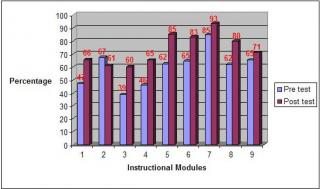
results and instructor's critical observations. The use of the modules
and the ink technology has improved student outcomes, as evidenced by:
1) better execution during the laboratory procedures, 2) improvement in
the results generated by the data obtained, 3) better analysis and
discussions of the end-results on student laboratory reports, 4) better
scores in the post-tests as compared to the pre-tests (see graphic
above), 5) improved quality of PowerPoint group oral presentations by
including multimedia tools such as animations, computer simulations and
video clips, among others. The survey results evidenced the students
satisfaction with the Tablet PCs Technology as a research tool to
obtain more information to solve the problems they encounter in the
development of a particular technique and to develop numerical and
graphical analysis. These outcomes suggest that students are developing
a good understanding of the laboratory techniques and their
applicability to research and industrial work. One year from know,
student outcomes will be measurable by electronic format lab reports,
computer base final exams, group oral presentations, student
satisfaction surveys, assessment pre and post-test results, and
instructor's critical observations. My goals will be to improve student
critical thinking, selfconfidence, and basic science related computer
skills. I also expect to improve on student and faculty course
management.
|
|
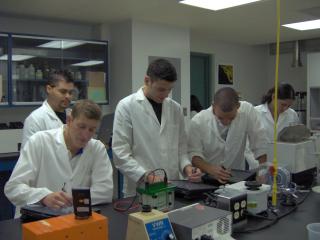
Students taking notes on experimetal observations
|
Programs
like this one, significantly contribute to improve on student and
faculty academic and professional performance. The students are
developing and applying basic information technology knowledge and
skills that can later carry on to other courses and, after graduation,
to their future jobs. The faculty, on the other hand, are revising the
course, adopting new outcomes assessment strategies, and sharing the
results of experimenting new teaching methodologies.
|
|
|
Quick Facts Department: Natural Sciences Department Courses Impacted: Laboratory on Cellular and Molecular Biology # Students Impacted: 75/ year # Faculty Involved: 1 This project is funded in part by a 2005 HP Technology for Teaching grant.
|
|
|
Contact Us Dr. Liza V. Jimenez liveji@hotmail.com, liveji@gmail.com ph. (787) 890-2681 ext 226, 230 http://cetempa.upr.edu/prof/pa0501/cursos/pa0501c01/Indice.asp
|
|
|
References & Publications George Lucas Educational Foundation, Edutopia. Professional development modules. http://www.edutopia.org/foundation/courseware.php Hayes,
M. and Billy, A. (2003) Web-Based Modules Designed to Address Learning
Bottlenecks in Introductory Anatomy and Physiology Courses. IMEj5(1). http://imej.wfu.edu/articles/2003/1/02/index.asp Online Academy, US Office of Special Education Programs. http://onlineacademy.org/acad/products/about.html The California State University Center for distributed learning. http://www.cdl.edu/ The Multimedia Educational Technology Center (MET-Center), UPR-Aguadilla. http://www.cetem.upr.edu
|
|
|