|
|
Provide a brief course description and suggest the intended learners. What are the learning objectives for this course? The
objective of the TEAL project is to transform the way physics is taught
in large introductory physics classes at MIT in order to decrease
failure rates and increase students' conceptual understanding, as well
as maintain analytic problem solving skills. Visualization technology
can support meaningful learning by enabling the presentation of spatial
and dynamic images that portray relationships between complex concepts. The
motivation for moving to a different mode of teaching introductory
physics courses was threefold. First, the traditional lecture and
recitation format for teaching the mechanics and electromagnetism
courses at MIT has had a 40-50% attendance rate, even with good
lecturers, and a 10% or higher failure rate. Second, a range of
educational innovations in teaching freshman physics has demonstrated
that any pedagogy using interactive-engagement methods results in
higher learning gains than the traditional lecture format. Finally,
unlike many educational institutions in the US and around the world,
the mainline introductory physics courses at MIT have not included a
laboratory component for over three decades. We felt this was a crucial
weakness, and we were intent on to re-introducing experiments into the
mainline courses in a meaningful way.
|
|
|
What are the major topics and how are the pedagogical contents organized? For electromagnetism, our major topics are in order: 1. Fields 2. Coulomb's Law 3. Electric Potential 4. Gauss' Law 5. Capacitors 6. Current and Resistance 7. Direct Current Circuits 8. Magnetic Fields 9. Sources of Magnetic Fields 10. Faraday's Law 11. Inductance and Energy in Magnetic Fields 12. Alternating Current Circuits 13. Maxwell's Equations and Electromagnetic Waves 14. Interference and Diffraction
|
|
|
Describe
the pedagogies (lecture, discussions, hands-on activities,
project-based) and the technologies you use (course website,
power-point presentations, blackboard), as well as the rationale for
any recent changes. The
TEAL project is centered on an active learning approach, aimed at
helping students visualize, develop better intuition about, and
better conceptual models of electromagnetic phenomena. Taught in
a specially designed classroom with extensive use of networked laptops,
this collaborative, hands-on approach merges lectures, recitations,
and desktop laboratory experience in a media-rich environment. In
the TEAL classroom, nine students sit together at round tables (Fig.
1), with a total of thirteen tables.
Five
hours of class per week is broken into two, two-hour sessions and a
one-hour problem-solving session led by graduate student teaching
assistants. The students are exposed to a mixture of presentations
(PowerPoint), desktop experiments, web-based assignments, and
collaborative exercises. The desktop experiments and computer-aided
analysis of experimental data provide the students with direct
experience of various electromagnetic phenomena. Course
materials and information are disseminated via a flexible course
website, to which instructors can individually add (or modify) content,
including lecture presentations, in-class problem solutions, problem
sets, office hours, and so on. In addition to the public site, a
private database-backed course management system keeps track of
student grades in real time as the semester progresses. Students
can log in at any time and instantly see how they are doing in the
class.
|
|
|
|
What
teaching methods, tools or publications, developed by colleagues at MIT
or other institutions, were helpful in developing your course? TEAL
(Technology Enabled Active Learning) is taught in the "Studio Physics"
format. This term loosely denotes a format instituted in 1994 at
Rensselaer Polytechnic Institute by Professor Jack Wilson. This
pedagogy has been modified and elaborated on at a number of other
universities, notably in North Carolina State University's SCALE-UP
program, under Professor Robert Beichner. Our format is closely to that
of NCSU.
|
|
|
What
pedagogical tools and materials were constructed to facilitate the
delivery of the curriculum and the students' understanding of the
subject matter? TEAL
incorporates advanced two- and three dimensional visualizations and
simulations that employ Java applets, Macromedia Shockwave
visualizations, and moves produced using 3ds max. These materials are freely available online.
They allow students to gain insight into the way in which fields
transmit forces by watching how the motion of objects evolve in time in
response to those forces. The animations allow the students to
intuitively relate the stresses transmitted by electromagnetic fields
to more familiar forces, for example those transmitted by strings and
rubber bands. In addition, a set of course notes
were developed specifically for the class, covering the topics listed
above and incorporating these visualizations as part of their
exposition. We are also developing problem sets that explicitly
integrate with and address our interactive simulations.
|
|
|
What are the most significant challenges for the students presented during this course? In
terms of subject matter, the basic difficulties in this course stem
from the fact that vector fields are something many students have
no feel for, and they have to master many aspects of this subject
to understand the physics.
In
terms of pedagogy, many students are passive learners because that
is the way they have been taught. Students had to be convinced that
using active learning techniques in teaching was indeed superior
to what they are used to. We cannot overemphasis the importance
of continually telling the students why you are doing what you are
doing and why it works better in terms of learning gains.
|
|
|
|
What refinements have been made to the course because of student feedback and assessment activities? Because
the TEAL Project has had a robust assessment effort from the outset, we
have been able to understand and document the successes and failures of
the implementation over the course of the last four years, and to learn
from them. For TEAL to succeed in the long term, it is crucial we
maximize the learning environment for the students. Since we feel that
class attendance is a central part of this teaching method, we
continually improve on the structure the course so that coming to class
is seen by the students as a profitable use of their time. The
refinements we have made over of the course of our four year
implementation are: (1) heterogeneous grouping, and more training of
students in collaborative methods; (2) more extensive training for
course teaching staff, both section leaders, graduate student TAs and
undergraduate TAs; (3) an increase in numbers of the course teaching
staff (students have felt that we were understaffed during class); (4)
fewer experiments that are better explained and better integrated into
the course material; (5) better planning of individual classes to break
our active learning sessions into smaller units that can be more
closely overseen by the teaching staff.
|
|
|
Provide examples of student work or other evidence that highlight how the teaching methods enhanced student understanding. The
TEAL Project has had a robust assessment and evaluation effort underway
since its inception. This effort is led by Professor Judy Yehudit Dori,
a faculty member in the Department of Education in Technology and
Science at the Technion. We use a variety of assessment techniques,
including the traditional in-class exams, focus groups, questionnaires,
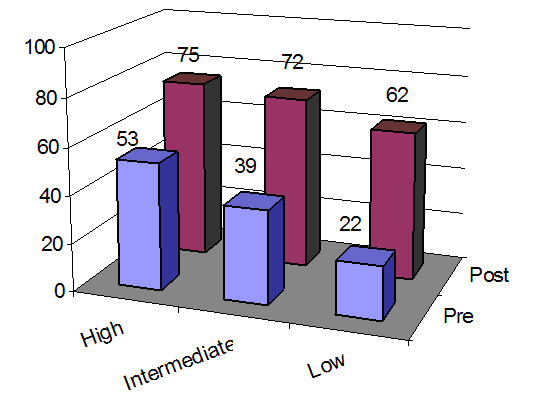
and pre and post testing. Our pre and post tests consists of 20
multiple choice questions covering basic concepts in electromagnetism.
Some of these questions are taken from standardized tests that have
been developed and used at other institutions, and some of these
questions were developed at MIT. The
figure above shows the results of the pre and post testing for Spring
2003 8.02. The results are given for three categories of student
scores: High, Intermediate, and Low. This separation allows us to gauge
the effectiveness of instruction across the range of student
backgrounds; the separation is made using the student score on the
pre-test. The difference between the pre and post scores is a measure
of the effectiveness of instruction. To
summarize those results, the learning gains in TEAL Spring 2003
by standard measures are about twice those in the traditional lecture/recitation
format across the entire range of student backgrounds. In particular,
we compared our results in TEAL to the standard MIT lecture/recitation
format taught in Spring 2002. The fact that interactive-engagement
teaching methods produce about twice the average normalized learning
gains when compared to traditional instruction replicates the results
of many studies obtained at other universities, including Harvard.
|
|
|