|

imagine the imagination
|
What is the focus of your investigation? I
have been teaching English for six years now; a relatively short amount
of time in the grand scheme of things. Yet, in this time, I have seen
English deform from a vibrant, dynamic, creative subject to a
constrained, objective driven and really quite dry product of the
National Literacy Strategy. With these changes in focus and delivery I
have also witnessed increased changes in pupil attitude toward the
subject.They no longer see it as an opportunity to be creative with
language, sparking off their imagination and emotion, but as an
increasingly difficullt and formulaic exercise in feature spotting and
conveying the 'right answers'. Now,
don't get me wrong, there have been tangible benefits of the Literacy
Strategy: improved punctuation, sentence structure and awareness of
writers'craft to name but a few. My intention here is not to suggest
that it is worthless, but I can't help but wonder if these improvements
are at the expense of the pupils' capacity for independent, creative
and imaginative responses. Surely children can't be becoming innately
less imaginative? I decided that I would like to begin to release the
imagination of some of my own more able pupils whilst still teaching
within the confines of the Literacy Strategy.
My original brainstorm
This was the product of a brainstorming session in which I tried to
formulate my thinking on the issue/subject that I wanted to tacklwe in
my action research. It was the fact that my interest lay in a similar
field to Donna's that enabled us to form a mentor/mentee bond based
primarily on our Action Research.
|
|
|
My initial definition of action research. Having
attended a couple of initial lectures for this MA I was introduced to
the concept of action research. We were asked to formulate our own
definition of action research and my initial thinking was as follows: I
believe that action research is developed from the desire to improve an
area of current practice. It is done within the context of daily work,
using my own teaching as the stimulus and context for research. Action
research is a self-centered and evaluative approach to improving my
practice, which would result in higher quality teaching and learning.
It is an organic and generative process and gives rise to new concepts
and approaches. Action research will allow me to use approaches that
are both self-refelctive and grounded in individual pupils. It allows
me to adapt methods of teaching according to what I find to be
effective or otherwise. Having
conducted, and whilst still conducting my action research, I believe
much of my original definition is still accurate. My drive for the
research is born out of the desire for self-improvement. The process
has been organic and has moved in different directions according to the
results the pupils achieved. One way that the process has suprised me
though, is that I have had to allow the pupils a higher level of
independence in the research than I had originally intended. (This is a
feature of my controlling personality that is detailed further in the
right hand column of this snapshot.) By allowing the pupils to own a
lot of the research I handed control of the project to them in lots of
ways. I regarded this as a gamble and it was a big step for me to take
a risk like this. However, the risk has paid off and, as a result, the
pupils have shown higher levels of commitment and enthusiasm for the
project. I have been amazed at their leadership skills, technical
ability (they did their snapshot in an hour where it took me a month!)
and sense of responsibility towards their work. They were also really
proud when they saw their efforts translated into lesson plans which
were to benefit other pupils in the group. This experience has shown
that, for me, action research is a liberating process that has enabled
me to loosen my 'classroom reigns' and take a few risks that I wouldn't
normally consider. The process of my still quite under-developed action
research project has been quite enlightening and extemely rewarding.
(For further information on how my reading on action research has aided
or changed my views please refer to the link PLTA at the bottom right
hand corner of this snapshot.)
|
|
|
What resources / references have you found helpful? As
my research is in its infancy,I have found it useful to share ideas
with my research mentor, Karly, who is doing a similar project. She and
I were able to discuss a variety of approaches to particular pupils and
clarify our intended outcomes. The focus of our research became quite
fluid as we refined our ideas until we reached a fixed point we were
happy with.I think to try and tackle this process alone would have been
quite restrictive but having a mentor to 'bounce' ideas off made it
much less intimidating a task.I also found it very usesful that Karly
was able to point out potential pitfalls in my plans and was able to be
a little more detatched from the issues that I am personally involved
in.From my discussions with her, I was able to view the issues from a
different perspective and modify my plans as necessary. One
of the things that really sparked off excitement in the pupils was when
I told them that we would be making short films and video diaries of
our research together. In an era when technology reigns, immediacy is
the key and the pupils liked the idea that they would be able to access
their findings on the internet and via moving image rather than
recording purely through writing. I also value the fact that using this
media, I will be able to capture the imaginative process in action. In
my developing research mentor relationship I have found it useful to be
able to contact my mentor via email. It has provided us with an easily
accessible and quick medium for having those snatched chats that formed
the basis of the early stages of our relationship. It has also enabled
us to check each other's progress over the internet and debrief from
the comfort of our own homes. It has meant that we have become really
quite involved in each others' work and it has been good to have such
easy access so that we are always up to date on changes and how the
other person might be feeling about them. My epiphany In
my readings around the subjects of Research Mentoring and Action
Research I stumbled across an idea given by Bridgit Somkeh 'Quality of
Educational Research'. She states that' much of what we do is guided by
either half-known or subconscious values and beliefs...we may be unable
to break the mould of routinised, ritualised actions, which have their
roots in these tacit and subconscious theories, hopes and fears' There
was a dawning realisation that my own classroom approach, which is one
of discipline, high expectations and rigid routines is actually a
product of the values that I hold dear. This realisation actually made
me a little uncomfortable as I also realised that until I am able to be
a little adaptable then change through action reserach will be very
difficult. It was a real epiphany for me and and as well as being tough
to face also gave me hope that it is possible to achieve.
|
|
|
What results have emerged? I
have been really encouraged by the pupils' response to the nature of my
project.They genuinely seemed to understand and empathise with my
objectives here and were pleased to have been selected. I was conscious
that I didn't want my selected pupils to feel that they were targetted
because they were underperforming. If anything, I selected them because
I feel that they have tremendous imaginative potential that I am not
tapping into very effectively and I want to further enrich their
learning. The
pupils have been instrumental in changing a fundamental approach to my
teaching. I am well known by my classes, and the rest of the school if
I'm honest, as a bit of a control freak. My classroom must be just so,
by books and files are organised by colour(I kid you not!) and I'm
really pernikerty about my little routines. The process of handing the
creativity over to a group of pupils was quite a big step for me. But
the response that I've had from the pupils; their enthusiasm and
commitment, their fresh, unblinkered approach was renewing and
regenerating. Just as I have been becoming stale in my teaching they
have rejuvinated my approach. If no other results come from this
investigation then it will have been worth it for that alone.
|
|
|
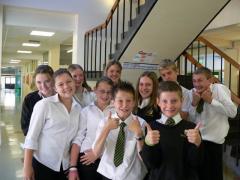
Examples of student work One
of the most refreshing experiences of this whole project for me has
been the enthusiasm and energy of the pupils involved. They have been
keen to research independently and have shared their findings honestly
and candidly. I find myself being constantly overwhelmed and taken
aback at actually how different the world of school and learning looks
through the eyes of the pupils. I have learned about their thoughts and
views on the issues I'm tackling and have been suprised and encouraged
by the volume of new ideas these have sparked; many of which I am
intending to use in the classroom before the year is out. Under this
commentary, there is a link to a separate snapshot that the pupils have
created to give their own comments and accounts of their initial
research with me. It makes entertaining and interesting reading. I
particularly like the section on whether being blind enhances a persons
imagination. I also became interested in how many pupils mentioned the
performing arts such as Dance as a method for expressing their
imagination. I am planning to deliver a set of lessons shortly which
will allow the pupils to express their outcomes in the mode of their
choice (art, poetry, song, dance, drama, modelling); a list inspired by
the pupils ideas. I shall report on the outcomes of this lesson later.
Pupil Snapshot
In this snapshot, the pupils I have been working with have given their
personal account of some of the research they have conducted and their
thoughts on what they have discovered
|
|
|

hold my hand to guide me through
|
How does my research help me to improve my mentoring? Having
imagination and creativity at the heart of action research is very
similar to my initial mentor's chosen focus. As a result of this shared
vision, we have approched the mentor sessions (which have basically
consisted of informal chats so far) on an equal footing; neither of us
being any more the 'expert' than the other. This has challenged my
typical hierarchical approch to mentoring. My only experience of
mentoring up until this project, involved me training and mentoring
someone less experienced than myself and so this approach has seemed
the most natural to adopt. This experience has provided me with a
refreshing change of perspective as a mentor. We
have been able to clarify each others' ideas and approaches to our
intended research. For example suggestions for questionnaires and
advice about approaching pupils. It has also been encouraging that we
can affirm each others tentative ideas and build self esteem; something
that I haven't normally got from prior experiences of mentoring! I
have felt that Karly has been encouraging yet probing in her approach
to my focus and I hope that I have been able to reciprocate this style.
|
|
|
Mentoring: a collaborative and fluid relationship. The
nature of undertaking a task such as research mentoring in a school
means that you are not allocated time within the school day to actually
liaise with your partner you have to snatch time with them as and when
you can.A our research projects have developed,I have found that Karly
and I have very different timetables and it has been increasingly
difficult to discuss any issues with her as the logistics of the school
day make it virtually impossible. Karly and I chose each other as
research mentors because our action research focus was similar.
However, I have found an more informal mentor relationship has
developed between myself and another colleague called Donna Chipping.
This began by the pair of us being equally baffled by the approach we
were to take to recording this research. Step by step, through trial
and error we found our feet(though Donna really must take the credit
for figuring out the more ICT heavy aspects of the research!) I found
that I began running my ideas past Donna and we would check each others
snapshots and provide helpful tips and comments. I have found this to
be a great support.Donna and I have had collaborative approach to our
informal mentoring of each other and through the changes in partner I
have found that a degree of flexibility and fluidity has been necessary
to allow this to happen. I hope that I have not taken time away from
Donna's original mentor/mentee and I have to confess about feeling
quite bad about not really seeing much of Karly. The
mentoring partnership that I have developed with Donna has progressed
quite unpredictably over time. (For a detailed account of the evolution
of this relationship please read the reflective journal that is linked
at the end of this section.As I write this we are nearing the end of
this unit of work and have reached a stage in our mentoring partnership
where we are actively asking each other out to engage in collaborative
and supportive work. I am suprised that this is the case because in my
initial musings on the practical application of mentoring in schools, I
raise the relevant point that there often simply isn't time in the
school day to undertake useful mentoring sessions and yet here I am
actively seeking out my mentor and engaging her in a collaborative
task! Today we have spent time reading each others work and providing
comments and suggestions. We have tried to 'spot the holes' in each
others writing, make sure that each area is covered and setting each
other targets to work on. This has been a useful session as I have read
this snapshot so many times that it is all swimming into one now! A
fresh pair of eyes was just what I needed. Indeed, as I type, Donna is
at my side waiting to read the next installment. I can't believe that
my mentoring experience has become such that I actively seek out
opportunities to meet and discuss my project with Donna and I really
hope that I can sustain this approach in other mentoring scenarios.
A growing relationship
In this journal you can read about how my relationship with Donna began
and how it grew. I have also reflected here on my own qualities as a
mentor to Donna and the improvements that have been, and need to be,
made.
|
|
|
The cycle of mentoring In
my development as a research mentor during my action research project,
I have been interested in the approach taken by Sarah Fletcher, our
course tutor, in mentoring our group here at school. She has guided me
through my initial work for our MA in a caring and gentle manner and
has always been extremely encouraging towards me. This has built my
confidence hugely over the past few weeks. Sarah's way is to listen to
issues that I raise, to calm and soothe me when I get a little ICT
stressed. She gently suggests alternatives, asking me whether I have
considered this, that or the other. I have come to realise that even
though the mentor relationship between us is not on a professionally
equal level (she is much more experienced than me!)I have not felt like
the receptor of the apprenticeship model in action (please refer to my
ideas on this later in this snapshot). Sarah has very much allowed me
to make my own choices and decisions but has taken an active role in
guiding and supporting me towards them. It has made me see that the
apprenticeship model, that I always associated with being used when the
mentor relationship was not built on an equal footing, is not
necessary. I believe that I have had a much more positive experience
from being mentored by Sarah than I suspect any teacher trainees have
had from being mentored by me. I have been gratified to hear that Sarah
had liked and been interested in my work and ideas.I would like to
think that she was able to take some positive personal experience from
my action research and thoughts on research mentoring, making our
mentoring relationship more of a two way process. As a result, I
believe I have, so far, had a very positive model of how a mentoring
partnership can work and it has made me consider and reflect on Donna
as my partner and how I can better mentor her.This is a cycle of
mentoring at work.I have had a positive experience as a mentee and I
that is now spilling over into wanting to create an equally positive
experience for my mentee as well as for myself as a mentor.I want to
try and encorporate the approches that Sarah has taken with me into my
developing mentoring style. In the attached link, I reflect in more
detail what I consider to be my weaknesses in my mentoring and how I
wish to improve. The
positive experience I have had through mentoring Donna has led me to
reflect upon what it is that made the partnership such a success. I
think that it was because it was just that...a partnership. We both
started from the same point of being quite fiercely independent and
preferring to work by ourselves. When we tentatively formed our working
partnership, it led to an evolution of thought on how mentoring can
work for the benefit of both parties. We came to this understanding
independently of each other and were quite amazed at the similarities
in our thinking. I believe that we are similar in our approaches and
our mentoring needs have developed along the same lines. We both feel
insecure about our own abilities and appreciate regular praise and
feedback. We both worry about our listening skills and yet we are both
willing to give each other the time needed to build these skills up. I
think the parellel changes in our thoughts about mentoring are a
tribute to the success of our partnership and how we have both grown.
Donna's qualities
This is a link to brainstorm on the qualities I have observed in Donna
during my time as her reserach mentor. It includes reflections on how
she has approached me as her research mentee/mentor and the attributes
she has brought to our relationship. There are many qualities that I
aspire to here and am consciously trying to repsond to her with similar
approaches.
|
|

A network of new relationships
|
Ongoing personal and school-wide benefits of my action research and research mentoring I
think that my primary desire is that the pupils will get more enjoyment
and stimulation from my lessons as a reult of the research I am
conducting. From my experience, if a pupil is stimulated by and enjoys
a particular lesson then this will, in turn, influence their
achievement in this area. With an increse in individual pupil
achievement, the issues and approaches that I hope to discover will be
delivered to a wider cohort of pupils and should therefore begin to
have a positive influence on class and, in turn, school achievement,
which, of course, is central to the overall aims of the school. Perhaps
this might encourage more staff to experiment and research in this way,
which would enable the school to develop into a teacher and pupil
centered environment over which staff have genuine influence, rather
than feeling that they are simply there to deliver a pre-determined,
government-driven stack of objectives and targets (ooh..spot the
cynic!). I
also hope to develop more personal relationships with my target pupils
through sharing, adapting and remodelling ideas. Involving each member
of the research 'team' on an equal level promotes as sense of
individual value that many pupils don't get a chance to
experience.Allowing pupils to grow as individuals in this way is
essential in the school producing the well rounded pupils it craves. Certainly
I hope to develop my experience as a research mentor on an equal
footing. My experience of this project so far has encouraged a dramatic
u-turn in my preconceptions and prejudgements on mentoring and what the
process involves. I hope that I am able to promote, through
demonstration and discussion, what mentoring now means to me: a
supportive, constructive, reflective and holistic process of
professional development. If school based mentors approach mentoring in
this manner, then the process, I believe, will become a much more
palatable and rewarding process.
|
|
|
|
My initial approach to Action Research I
decided to focus on a group of twelve pupils within my able year eight
group. All twelve pupils achieved a 5b or 5a in their KS2 SATs and I
consider each to be articulate, bright and enthusiastic about their
learning. I decided to use year eight as there tends to be a lack of
definition given to the yr group. Year seven have the pressure of
transition between KS2 and KS3 and the year nines have the pressure of
the coming SATs. In my experience,year eights can often underachieve as
they lose motivation and focus. I
am quite aware that I have a bit of a 'bee in my bonnet' about how the
Literacy Strategy constricts imaginative response and I was curious to
know whether the pupils themselves actually consider this to even be an
issue for them, let alone be something they would like to see improved.
In order to give my research a starting point, I designed a
questionnaire that allowed the pupils to respond honestly and frankly
about issues such as how they feel about their imaginative capacity,
what stimulates their imagination, how they express it and whether they
even consider it to be an important asset. From this,the pupils will
share and discuss their thinking with the research group which will
give me a starting point. THE DISCUSSION The
questionnaires that I gave the pupils to answer involved a lot of
probing thought on their behalf. I was interested in their views on
their own imagination and its usage, as well as the importance they
place on it in facilitating their learning or as a tool for
experiencing everyday life. They answered the questionnaires as
individuals to enable them to form and consolidate their personal
opinions and thoughts but I then asked them to discuss their ideas with
their peers from the target group. Their responses were very
interesting. They all felt that their imagination was a very important
faculty and the majority of them felt they probably didn't use it
enough. What suprised me though was that they generally felt that their
English lessons already allowed them freedom to be imaginative;
something I am not keen to agree with. This made me wonder whether they
were giving these responses because I, their English teacher,was asking
their opinion or whether they have simply lower expectations of
themselves. I also wonder how much of this is another conditioned
response to the Literacy Strategy? Was it because they have not been
educationally raised on the imaginative subject I know English to be? The
pupils, in their discussion, came up with some fantastic ideas for how
I could teach to allow more imaginative responses form my pupils. They
suggested responses through drama, dance, music, artwork, modelling,
poetry etc. This was a real 'lightbulb' moment for me. I realised that,
providing I could assess these against the Strategy critera and that
they would link to the teaching objectives, there is no reason why I
couldn't try some of these approaches in the whole class lessons.I am
really proud that the sparks for these ideas came from the pupils
themselves and they are really excited about being able to have some
influence on their own lessons. I plan on trialling some of these in the near future.
pupil questionnaire
Here you will find the questions that I gave to the pupils in order to
begin a dialogue with them on their feelings about imagination. These
questions then became the stimulus for a lengthy discussion between the
pupil (which I captured on video and hope to provide a link to.) It
also sparked off their interest in finding out alternative views on
this subject. From this they adopted the role of pupil researcher and
conducted and taped interviews with selected peers and staff to
discover other views on imagination.
|
|

you WILL learn from me
|
My feelings on mentoring. I
find the task of self-reflection a difficult yet useful tool. As a
typical stubborn Aries, I am not especially good at accepting
criticism, however constructive, even when it comes from myself! As I
have started this research I have been forced to consider my own mentor
style and how succesful it has been in the past. Through my reading and
more recent experience of being a research mentor, I have been forced
to reassess my approach to being a mentor and I am also having the
novel experience of being a mentee. I began by trying to define my preferred approach, chosing from the following categories 'Letting go' style 'Active listening' style 'Advisory' style 'Prescribing' style 'Cooperative' style. I
decided that I best fit into the 'prescribing' style with elements of
'Advisory'. The primary characteristics of this approach would be
taking responsibility for the mentee's problems, offering instructions
or advice on how to rectify the problems and requiring specific
improvement. When I conducted a self-evaluative questionnaire designed
to discover my mentor stytle, it turned out that my initial self-
assessment was, in fact, absolutely correct. I felt a little sheepish
and embarrassed by this as, when defined in these terms, it sounds a
little like professional bullying!(I consoled myself by remembering
that I was responsible at the time for getting NQTs and ITTs to the
required level to pass their course.) However, I am beginning to
recognise that there are different ways of doing this. Fletcher (2000)
states that 'mentoring should unblock the ways to change by building
self-confidence, self-esteem and...is concerned with continuing
personal as well as professional development. I very much doubt that my
mentees saw it this way! On reflection, I agree with this as an ideal
to be aspired to and it has challenged my outlook in a short space of
time. I
have painted a rather negative picture of my mentoring and I feel that,
actually, there are many reasons why this was the way that I, and I
believe a great many teachers, approach mentoring. As
I was reading around this area, I discovered that my preferred style
had been categorised by Mullen and Lick (1990) as a one-way
apprenticeship based model. Fletcher states that 'the apprenticeship
model is still prevelant rather than the two way enquiry process that
can assist in building personal and professional development'. I felt
that there was an implicit criticism in this statement that needed
addressing. I agree that it is the case but I believe that it is
largely a result of the context of school based mentoring that most
teachers are faced with. Mentoring NQTs and ITTs is not an equal
process on an experience, knowledge or confidence level, plus the
mentor is under pressure to get the mentee to pass a set of specified
standards. This is bound to result in the mentor placing the emphasis
on imparting knowledge and skills. Fletcher
goes on to state that 'both mentor and mentee are seeking to improve
their work based practice.'. Again, I agree in principle but in
reality, this is not how mentoring is introduced in schools. Teachers
are commonly simply told that they will be responsible for mentoring a
given person and this usually involves helping them to improve in some
way. Also,
when mentors are selected, there is often little or no training given
to help them to formulate a suitable approach, resulting in them simply
attempting to pass on their skills, according to the apprenticeship
model. In
addition to this, mentoring, in my experience, is commonly viewed by
the teacher as a time-consuming extra 'add-on' for which they are not
trained or often have not requested. The fact that the mentor is
generally expected to take on this weighty and expansive role without
having allocated time or financial renumeration often adds to a
negative view that mentoring is not something that they themselves will
actually gain from, which is Fletcher's ideal. Despite
all of this, I agree that this situation is generally not beneficial
for mentor or mentee. I think that the ideal that Fletcher is striving
for is worthy but it is helpful to remeber that for this to happen, it
need to take place within the realistic confines of the school
environment. CHANGES IN MY VIEWS. My
readings on Research mentoring have led me to belive that it is a more
equal process because it is based on shared experience, similar focus
and promoting self relfection rather than imparting knowledge. This
leads me to believe that the nature of mentoring is conditioned by the
intended outcomes and the needs of the mentee primarily. sometimes it
is necessary to adopt an apprenticeship model in order to affect
significant improvement in knowledge or skills in a new or training
teacher. As they gain confidence and experience, the mentor/mentee
relationship could shift to a more equal footing. When mentoring a
person of similar experience (in a given area) to your own, be it of
many years or none at all, the process would be more equal as both
roles are filled by people who are gaining from the situation. A good
mentor should therefore be able to adapt their approach according to
the needs of the mentee and the intended outcomes of the mentoring. In
my capacity as a research mentor, I have come to realise that, contrary
to my previous experience, mentoring is not just about achieving
certain standards. I began the process of research mentoring on equal
footing with my mentee and, from the start, because the outcome was an
objective we were both striving for, the relationship was one of mutual
support and encouragement. It has taught me that being a mentor can
actually be enjoyable, comforting and of some personal benefit as
opposed to stressful, time-consuming and unwanted (my previous
experiences of being a mentor!)Using Action Research as common ground
gave us an immediate bond and common purpose. As a result I have become
genuinely interested in my research mentee and their progress as a
professional, a student working towards an MA and a friend. I have been
amazed that mentoring has provided me with this experience and I think
the key difference has been that we have started with the same initial
purpose. THE JEDI APPROACH. I
was my reading of Brooks and Sikes (1997)that challenged the benefits
of my (previously) preferred apprenticeship style. They suggest that
this mode of training, that is suited to passing on lower order craft
skills through simple demonstration is actually unsuitable for
mentoring a teacher as teaching is a more intellectually demanding,
higher order profession. Teaching is not simply a collection of skills
that can be practised and refined then applied. I realised from this
that teacher mentee can't simply duplicate a style: they have to
develop it for themselves and therefore the apprenticeship model isn't
appropriate. This was another 'light bulb' moment for me as previously
I had been thinking within the constraints of having to get a mentee to
a particular standard, rather than seeing mentoring as a person-wide
process. In discussion with my husband, he likened this to a Jedi
Master mentoring their Paduan Learner. The Jedi encourages a holistic
and individual development rather than simply replicating a clone of
themselves (every pun intended!)They encourage their mentees to
experience, reflect and learn, which is perhaps a model to aim for.
The PLTA
THIS IS A DETAILED RECORD OF MY READINGS ON ACTION RESEARCH AND
RESEARCH MENTORING. IT INCLUDES MY THOUGHTS ON THE LITERATURE AND
WHETHER IT INFLUENCED MY THINKING
|
|
|